 Free UK shipping
 Results in under 14 days
 UK lab
10% Off All Tests - March 2026




Introduction to Olanzapine
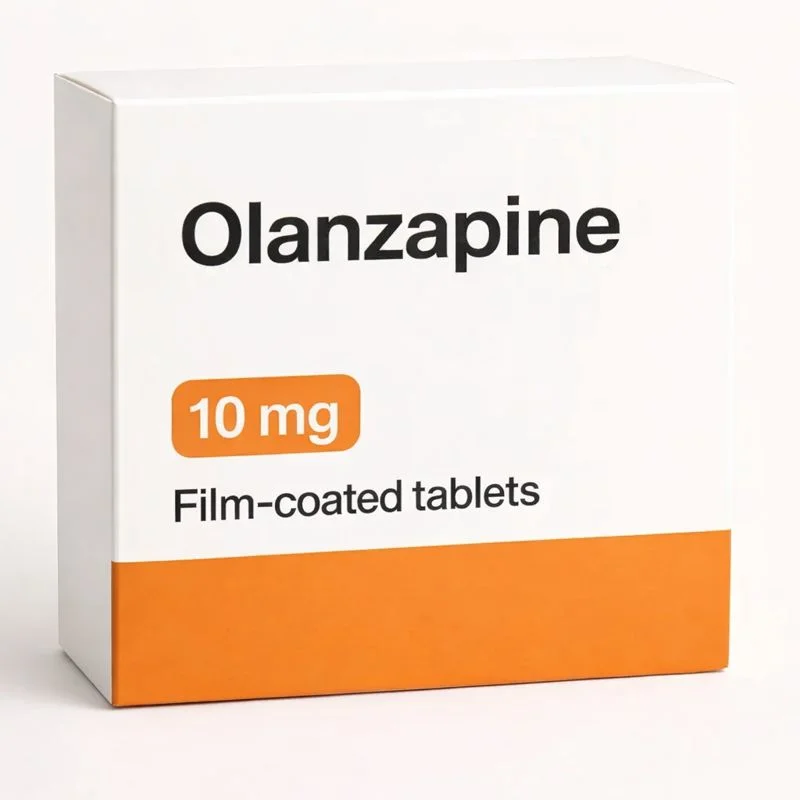
Olanzapine is an atypical, or second-generation, antipsychotic (42, 50). This group of medicines generally causes fewer Parkinson’s-like movement side effects than first-generation antipsychotics, because their clinical effect is not driven by strong, sustained blockade of dopamine D2 receptors (44).
Beyond its core antipsychotic effects, olanzapine has also been associated with anti-inflammatory and neuroprotective properties, which may contribute to its overall clinical impact in real-world settings (47, 50).
Considerations for Patients Taking Olanzapine
Olanzapine is often described as an effective and reliable antipsychotic in clinical practice, but it also has a distinct side-effect profile that is important to understand before and during treatment. In particular, olanzapine is known for having a higher risk of weight gain and metabolic change than many other second-generation antipsychotics, so treatment works best when both symptoms and physical health markers are monitored over time (42, 43, 49, 51).
Reduced Parkinson’s-like Side Effects
Compared with older antipsychotics, olanzapine is less likely to cause movement-related side effects linked to dopamine blockade. This includes symptoms such as involuntary muscle contractions (dystonia) and inner restlessness or difficulty staying still (akathisia) (44).
That said, “lower risk” does not mean “no risk”. If any new movement symptoms appear, they should be discussed with a clinician early rather than ignored.
Subjective Effects and Day-to-Day Feel
Some antipsychotic medicines can leave people feeling emotionally flattened, less motivated, or less able to enjoy life. This kind of subjective negative experience can be one reason why people stop treatment early. Olanzapine is often considered more tolerable than first-generation antipsychotics in this respect, although individual experience still varies widely (42, 43, 49, 51).
Prolactin Effects
Olanzapine is less likely than older antipsychotics to cause major prolactin elevation (hyperprolactinaemia). This matters because chronically elevated prolactin can contribute to sexual dysfunction and fertility issues, and it can cause hormone-related symptoms in both men and women (42, 43, 49, 51).
Explore PGX for Mental HealthWhy Have I Been Prescribed Olanzapine?

An antipsychotic with several uses
In the UK, olanzapine is licensed for schizophrenia, combination therapy for mania, prevention of recurrence in bipolar disorder, and the rapid control of agitation in schizophrenia or mania (16).
Olanzapine may be selected because it is a well-established option with strong clinical outcomes in real-world practice, particularly where symptom control is the priority. In many patients it can provide a stable reduction in psychotic or manic symptoms, and may be used both short-term and longer-term depending on the clinical situation (16).
Olanzapine Doses

How and when to take it
Olanzapine dosing depends on the condition being treated, the route of administration, and the individual’s metabolism and tolerance. In UK practice, dosing is adjusted according to response, and higher doses are generally only used after reassessment. People who may metabolise more slowly, including females, older adults, and non-smokers, may be started on a lower dose with more gradual increases (16).
Factors That Can Affect Olanzapine Levels
Some real-world variability in olanzapine response is explained by differences in drug exposure.
Women can show higher olanzapine plasma levels, which may reflect lower activity of CYP1A2, one of the key enzymes involved in olanzapine metabolism.
Smoking status is also important. Tobacco smoke can induce drug-metabolising enzymes and increase clearance of olanzapine, resulting in lower blood concentrations. In active smokers, olanzapine clearance can be higher, and levels may be lower at the same dose (42, 43, 45, 46).
This is why changes in smoking habit should always be communicated to the prescribing team.
Olanzapine Side Effects
Like all antipsychotic medicines, olanzapine can cause side effects, and the pattern is not the same for everyone. Some effects are linked to its action on dopamine and serotonin signalling, while others relate to its impact on histamine, muscarinic, and adrenergic receptors. In practice, the side effects that matter most are often those that affect day-to-day function, such as sedation and cognitive slowing, and longer-term metabolic changes such as weight gain and shifts in blood sugar or cholesterol. This is why olanzapine treatment works best when it is monitored over time, balancing symptom control with physical health markers and individual tolerance (42, 43, 49, 51).
Side Effects That Matter Most in Older Adults
Older adults are more sensitive to several side effects that can occur with olanzapine, particularly those involving blood pressure, balance, and cognition. Postural hypotension, which causes dizziness on standing, increases fall risk and can be dangerous in frailer patients.
Cognitive effects also matter in this group. Sedation, slower thinking, or confusion may be more noticeable, and may overlap with age-related changes, so monitoring is important.
Finally, metabolic effects are particularly relevant in older adults because baseline cardiovascular risk is often already higher. Olanzapine has one of the highest propensities within second-generation antipsychotics to cause meaningful weight gain and metabolic disruption, with a profile often considered comparable to clozapine in this regard (42, 43, 49, 51).
Metabolic Side Effects in Children and Teenagers
Olanzapine can cause significant weight gain and metabolic disturbance in younger people. This includes changes in cholesterol and triglycerides, and in some cases progression toward full metabolic syndrome. Some data suggest notably higher rates of metabolic syndrome in treated adolescents compared with controls, which is why careful physical health monitoring is essential when olanzapine is used in this age group (42, 43, 49, 51).
Explore PGX for Mental HealthHow Your Body and Genes Process Olanzapine
Olanzapine’s pharmacokinetics help explain why it can feel different from person to person, and why lifestyle factors such as smoking can meaningfully affect clinical response (42, 43, 45, 46).
 Absorption
With daily use, olanzapine reaches steady-state plasma levels in around one week. The time to peak concentration is around 6 hours for oral formulations and roughly 15 to 45 minutes for intramuscular administration. The elimination half-life ranges widely, from around 21 to 54 hours, with an average close to 30 hours (42, 43, 45, 46).
 Distribution
Olanzapine is metabolised primarily through liver glucuronidation, and this pathway does not rely on the CYP450 system. A second relevant pathway involves CYP1A2 metabolism to inactive metabolites (42, 43, 45, 46).
 Elimination
Olanzapine is eliminated with a half-life averaging around 30 hours, and it is excreted mainly via the kidneys (57%) and to a lesser extent in faeces (30%) (42, 43, 45, 46).
Personalising Olanzapine with Pharmacogenetics
There is currently no official CPIC guidance for olanzapine dosing based on pharmacogenetics, which reflects the complexity of clinical response and the current state of evidence. In practice, response and tolerability are still guided primarily by clinical monitoring and physical health tracking over time.
What This Means for You
If you are taking olanzapine, it is worth being proactive and structured about monitoring. In particular:
If you are older, pay attention to dizziness, balance changes, and confusion, and avoid sudden postural changes.
Track weight and appetite, and discuss proactive lifestyle support early, not only once weight gain becomes difficult to reverse.
If olanzapine stops working as well as it used to, or side effects increase over time, raise it with your clinician rather than assuming it is something you must tolerate.
Report any change in smoking status, including cutting down, quitting, or restarting.
Most importantly, do not adjust the dose independently. Olanzapine is best managed with gradual, clinician-led adjustment tailored to your response and risk profile (16).
Related Medications:
Other antipsychotic medicines include:
- Clozapine
- Haloperidol
- Quetiapine
- Perphenazine
- Thioridazine
- Zuclopentixol
References
(1) https://www.ncbi.nlm.nih.gov/books/NBK535399/ (2) https://www.mdpi.com/2226-4787/12/3/92 (3) https://www.mdpi.com/2075-1729/15/6/830 (4) https://journals.plos.org/plosone/article?id=10.1371/journal.pone.0319037 (5) https://www.researchgate.net/publication/355704819_Reduction_in_Absolute_Neutrophil_Counts_in_Patient_on_Clozapine_Infected_with_COVID-19/link/617bc54beef53e51e1ff566f/download?_tp=eyJjb250ZXh0Ijp7ImZpcnN0UGFnZSI6Il9kaXJlY3QiLCJwYWdlIjoicHVibGljYXRpb24iLCJwcmV2aW91c1BhZ2UiOiJfZGlyZWN0In19 (6) https://pmc.ncbi.nlm.nih.gov/articles/PMC7947876/ (7) https://www.nature.com/articles/s41598-020-78474-0 (8) https://www.sciencedirect.com/science/article/pii/S0167527324001189 (9) https://www.researchgate.net/publication/369533176_Second_to_none_rationale_timing_and_clinical_management_of_clozapine_use_in_schizophrenia (10) https://www.mdpi.com/2227-9059/12/10/2294 (11) https://link.springer.com/article/10.1007/s40263-025-01236-x (12) https://pmc.ncbi.nlm.nih.gov/articles/PMC6449846/ (13) https://pmc.ncbi.nlm.nih.gov/articles/PMC8883353/ (14) https://www.mdpi.com/1422-0067/24/2/1243 (15) https://pmc.ncbi.nlm.nih.gov/articles/PMC8301879/ (16) https://bnf.nice.org.uk/ (17) https://www.nature.com/articles/s41380-023-02026-x (18) https://www.rightdecisions.scot.nhs.uk/tam-treatments-and-medicines-nhs-highland/adult-therapeutic-guidelines/mental-health/clozapine-initiation-and-re-titration-specialist-mental-health-guidelines/?utm_source=chatgpt.com (19) https://pmc.ncbi.nlm.nih.gov/articles/PMC7766585/ (20) https://pmc.ncbi.nlm.nih.gov/articles/PMC8061735/ (21) https://pmc.ncbi.nlm.nih.gov/articles/PMC4915939/ (22) https://www.sciencedirect.com/science/article/pii/S0378427425015802?via%3Dihub (23) https://www.ncbi.nlm.nih.gov/books/NBK547739/ (24) https://pmc.ncbi.nlm.nih.gov/articles/PMC9889418/ (25) https://pmc.ncbi.nlm.nih.gov/articles/PMC5725548/ (26) https://www.nature.com/articles/tp201794 (27) https://link.springer.com/article/10.1007/s40263-015-0278-3 (28) https://www.nature.com/articles/s41598-022-16130-5 (29) https://pmc.ncbi.nlm.nih.gov/articles/PMC6127750/ (30) https://www.ncbi.nlm.nih.gov/books/NBK534115/ (31) https://www.nature.com/articles/s41537-021-00158-z (32) https://share.google/FdL5w8u4av4rGaGWq (33) https://www.sciencedirect.com/science/article/pii/S0278584624002021 (34) https://cpicpgx.org/wp-content/uploads/2020/12/2020-Dec-CPIC-Antipsychotic-PGx_Final.pdf?utm_source=chatgpt.com (35) https://www.ncbi.nlm.nih.gov/books/NBK459145/ (36) https://pmc.ncbi.nlm.nih.gov/articles/PMC4316978/ (37) https://www.ccjm.org/content/88/5/286 (38) https://pmc.ncbi.nlm.nih.gov/articles/PMC3770982/ (39) https://pmc.ncbi.nlm.nih.gov/articles/PMC5348850/ (40) https://pmc.ncbi.nlm.nih.gov/articles/PMC12272296/ (41) https://www.mdpi.com/2673-9879/2/3/18 (42) https://www.ncbi.nlm.nih.gov/books/NBK532903/ (43) https://pmc.ncbi.nlm.nih.gov/articles/PMC10749543/ (44) https://pmc.ncbi.nlm.nih.gov/articles/PMC5327459/ (45) https://www.tandfonline.com/doi/full/10.2217/pgs-2021-0051 (46) https://www.researchgate.net/publication/376785202_Olanzapine_Pharmacokinetics_A_Clinical_Review_of_Current_Insights_and_Remaining_Questions (47) https://pmc.ncbi.nlm.nih.gov/articles/PMC11684224/ (48) https://pmc.ncbi.nlm.nih.gov/articles/PMC9369504/ (49) https://link.springer.com/article/10.1186/s41983-023-00612-y (50) https://www.mdpi.com/1424-8247/13/12/457 (51) https://pmc.ncbi.nlm.nih.gov/articles/PMC5499790/